Top computer hardware news

Friday, October 29, 2010

Microsoft updates Internet Explorer 9 test version

Microsoft CEO Steve Ballmer talks to PDC 2010 attendees about HTML5.

Microsoft CEO Steve Ballmer talks to PDC 2010 attendees about HTML5.

(Credit: Josh Lowensohn/CNET)

REDMOND, Wash.--Microsoft kicked off its Professional Developers Conference today, releasing an updated test version of Internet Explorer 9, the company's effort to reassert itself in the Web browser market.

"We've tried to make the Web feel more like native applications," CEO Steve Ballmer said as part of a keynote speech this morning.

The update is a new platform preview that developers can use to test Web sites, but is not an update to the more full-featured beta version that Microsoft released earlier this year. Microsoft had said it would continue to update the platform preview versions for developers even after releasing the beta. Unlike the beta, the platform preview can be used alongside earlier versions of the browser. Microsoft said there won't be a second beta of IE9, but there will be a near-final "release candidate" before the final version is released.

Ballmer also talked about coming improvements to Windows Azure and noted that it expects to have more than 1,000 apps for Windows Phone when the devices go on sale November 8.

"We're driving hard," Ballmer told a crowd at the Microsoft conference center here. Although he talked about Windows 7, phones, and the browser, Ballmer stressed the role the cloud is playing in all areas of computing. "The cloud is a backplane on which to program and rapidly deploy applications. These are powerful new platforms."

A demonstration of Amazon's just-announced Kindle app for Windows Phone 7

A demonstration of Amazon's just-announced Kindle app for Windows Phone 7

(Credit: Josh Lowensohn/CNET)

Ballmer said that HTML 5 is the glue that will allow all kinds of new programs and devices to emerge.

Microsoft changed the format of its conference this year, having fewer people at the conference itself, but broadcasting it on the Web and having 30,000 people at local events worldwide.

Ballmer also took a moment to tout Microsoft's consumer efforts, touting Windows 7 PC sales, the release of Windows Phone, as well as the gesture-recognizing Kinect add-on for the Xbox 360.

"It is really remarkable," he said.

As for the phone, Ballmer said, "I think we really kind of nailed it," noting that it is more personal, offering more options than a one-size-fits-all approach (i.e. Apple) while offering more coherence (clearly a knock on Android).

Microsoft showed several Windows Phone apps including Facebook, a TurboTax title from Intuit, and, for the first time, the Kindle app for Windows Phone 7.

Ballmer also excited the crowd by telling the developers in attendance that each of them would be getting a free Windows Phone. Paid attendees will also get a free registration for the Windows Phone marketplace and Ballmer urged them to write some cool programs for their phone.

"We need your best work," he intoned, promising that in return Microsoft is going to put its full marketing muscle behind the new phone operating system.

Ballmer also showed the crowd some of the advertising for Windows Phone 7--ads that depict the phone as easy to access at a glance, contrasting humorously with current smartphones which often have users with their heads buried in their device as life passes them by. "Man, are we going to pump and thump," Ballmer said of the company's ad push for the new phones. "You're going to see a lot of these ads."

On the PC front, Ballmer said, as he has frequently, that Windows 7 machines will take new shapes and forms in the coming year, but didn't announce any new efforts on that front. The company has been under pressure to offer up a competitive response to Apple's iPad.

Bob Muglia, Microsoft's president of the server and tools business, talks about upcoming additions to the Windows Azure platform.

Bob Muglia, Microsoft's president of the server and tools business, talks about upcoming additions to the Windows Azure platform.

(Credit: Josh Lowensohn/CNET)

"You'll see people push," he said, noting ink (the ability to write onscreen using a stylus) and touch is built into Windows 7.

Ballmer gave way to server and tools boss Bob Muglia, who talked about Microsoft's effort to move from selling server software to offering tools and services for a world in which businesses can move more of their efforts to the cloud.

Muglia noted that, while it is a major shift, the move offers the ability to shift work from IT managers who today spend much of their time dealing with patches, updates, and other maintenance work.

"You are dealing with a lot of changes that aren't helping you," Muglia said. "That is all a lot of work," he said.

Windows Azure, Muglia said, allows businesses to offload much of that work. Even other virtualization options, he said, require hands-on work from businesses. "With today's world there is a lot of assembly required."

Microsoft announced some new options for Azure, including a lower-priced tier of the service as well as enhanced capabilities for moving existing virtual machines and applications onto the cloud-based operating system. The company also plans to add the ability to create virtual machines on Azure.

The goal, Muglia said, is to give businesses more time to spend on the applications that benefit the bottom line. To highlight the point, Muglia brought Disney's Pixar on stage to talk about how Azure will allow smaller moviemakers that can't afford their own huge data center farm the ability to use high-end rendering software.

Pixar's Chris Ford said the company has moved its RenderMan rendering software--an application that runs on Windows, Mac and Linux--to Windows Azure, which allows smaller studios to tap into the cloud only when they need server capacity.

In addition, Microsoft announced it has finalized a new marketplace for Windows Azure including a way to get data feeds, known as DataMarket. Formerly known by its "Dallas" code name, DataMarket allows companies to sell or make available for free various feeds that application makers can include in their programs.


Amid criticism, WikiLeaks shifts focus

When WikiLeaks launched with little fanfare in early 2007, its founders touted it as a unique collaboration that would rely on the same anyone-can-edit software and sense of community that made Wikipedia such a success.

Instead of having a small group of experts examine documents, WikiLeaks promised, the forthcoming Web site would allow "the entire global community" to "interpret documents and explain their relevance to the public." News coverage at the time quoted spokesman Julian Assange emphasizing the lack of hierarchy, saying WikiLeaks is "an international collaboration, primarily of mathematicians."

WikiLeaks

That was then. In the nearly four years since its launch, WikiLeaks has morphed from a friendly collaboration of like-minded geeks to an operation dominated by Assange's London press conferences and outsized personality.

Instead of the informal global collective of mathematicians and programmers that once existed, according to internal e-mail messages reviewed by CNET, Assange has become a force so formidable that he kicked out Daniel Schmitt, the organization's second-best-known representative. Schmitt told Der Spiegel last month that "there is a lot of resentment there and others, like me, will leave."

Assange did not respond to queries for this article.

The group's focus also has changed. At its inception, WikiLeaks announced that "our primary interests are oppressive regimes in Asia, the former Soviet bloc, sub-Saharan Africa and the Middle East." Since the summer, the group has focused exclusively on the United States--in particular, its controversial military adventures abroad.

Also, all documents not related to the Iraq war files have been removed from WikiLeaks.org, and no submissions are currently accepted. And instead of continuing the Wiki-based approach that allows "the entire global community" to participate, WikiLeaks has given exclusives to a handful of mainstream media organizations and no longer allows the public to comment on documents.

Especially since the summer release of the Iraq war files, Assange has encountered a barrage of criticism, including a profile in the New York Times last weekend that used language such as "erratic and imperious behavior" and "a nearly delusional grandeur." The Obama administration has accused him of violating U.S. law, and some of the more strident conservatives have called for cyberattacks on Wikileak's servers, with a Fox News commentator implying that Assange could be legally assassinated as an "enemy combatant."

"He's paranoid about agencies stalking him," says Jim Lewis, a senior fellow at the Center for Strategic and International Studies in Washington, D.C.

Whether it's paranoia or sheer common sense, that sentiment is hardly new.

The birth of WikiLeaks
It was a humble text-only mailing list called cypherpunks, hosted by Electronic Frontier Foundation co-founder John Gilmore, that laid the philosophical foundation for WikiLeaks. Longtime cypherpunk John Young, a New York architect, was the first to register the WikiLeaks.org domain name but has since become a critic. (Full disclosure: I subscribed to the mailing list during that time.)

From 1995 through at least 2002, Assange and some of WikiLeaks' other founders spent thousands of hours debating strong encryption, offshore data havens, and how to use technology to obtain documents and then publish them anonymously. The discussions there seemed to be a decade ahead of their time: list co-founder and Cyphernomicon author Tim May joked back in 1987 that strong encryption and anonymity would lead to someone offering: "Stealth bomber blueprints for sale. Post highest offer and include public key."

Today, that seems more plausible than not.

One common topic among the mostly libertarian-leaning cypherpunks is honing technological approaches to liberating information that a government or other influential organization would prefer to keep secret.

In a 1996 message, for instance, Assange announced a demonstration at the Scientology building in Melbourne in response to the church's aggressive legal attempts to remove its secret scriptures from the Internet. He wrote:

The fight against the Church is far more than the Net vs a bunch of wackos with too much money. It is about corporate suppression of the Internet and free speech. It is about intellectual property and the big and rich versus the small and smart. The precedents the Church sets today the weapons of corporate tirany [sic] tomorrow.

A year later, Assange announced that he had finished programming a beta version of a pioneering cryptographic file system, which he described as a "rubber hose proof" file system. The idea was to encrypt and hide data on a hard drive so thoroughly that it would be invisible to a government agency.

Government agents might suspect that some data existed, but they wouldn't be able to prove it. So even if the laptop's owner were tortured by being beaten with a rubber hose, he or she could claim that there was no more encrypted data left on the hard drive. As Assange put it at the time, "I can never prove that I have revealed the last of my keys. "

A 2001 cypherpunks post by Assange appears to preview his vision for what WikiLeaks would become: "Post-war U.S. liberties were usually restored after appalling abuses by the mendacious followed by intensive lobbing by civil rights activists. It'd be nice to cut the former phase short."


Is China a supercomputer threat? (Q&A)

With China expected to officially take the supercomputer performance crown next month, I asked an expert about the state of supercomputing in the U.S. and whether China poses a long-term threat to the United States' current preeminence in supercomputing.

Nvidia announced yesterday that its chips are powering the "Tianhe-1A" Chinese supercomputer that achieved 2.507 petaflops, beating a U.S.-based system that is currently ranked No. 1 on the June Top500 list of the fastest supercomputers in the world. The Chinese system is a unique hybrid design that uses approximately 7,000 Nvidia graphics chips along with 14,000 Intel Xeon CPUs. The graphics chips are what give the system the extra oomph to catapult it into the top supercomputer spot.

I spoke with Jack Dongarra, university distinguished professor at University of Tennessee's Department of Electrical Engineering and Computer Science and part of a group from the University of Tennessee, Oak Ridge National Laboratories, and Georgia Tech that recently purchased a hybrid system. It is important to note that Oak Ridge houses the supercomputer, dubbed "Jaguar," cited above that is currently ranked No. 1 in the world based on the Top500 June list: it is not a hybrid system.

Q: Does Oak Ridge have anything analogous to the Chinese hybrid system?
Dongarra: Oak Ridge has a small version of a machine that is hybrid in nature. So, this is an acquisition that just took place...out of a grant from the National Science Foundation. It involved Oak Ridge National Labs, University of Tennessee, and Georgia Tech. But it's much, much smaller than the Chinese system. The machine is in place and testing is being carried out at Oak Ridge. A node has two Intel Westmere chips and three Nvidia Fermi boards. There are 120 nodes in the system.

What makes the Chinese supercomputer so fast?
Dongarra: The Chinese designed their own interconnect. It's not commodity. It's based on chips, based on a router, based on a switch that they produce.

Is that in essence the secret sauce?
Dongarra: It's similar to Cray. Cray's contribution, besides the integration and software, is the interconnect network. They have a very fast interconnect that makes that machine perform very well. Though [the Chinese] project is based on U.S. processors, it uses a Chinese interconnect. That's the interesting part. They've put something together that is roughly twice the bandwidth of an InfiniBand interconnect [which is used widely in the U.S.]

Will the Chinese system in fact take the No. 1 spot on the Top500 list in November?
Dongarra: Yes. I saw the machine. I saw the output. It's the real thing.

Why doesn't Oak Ridge do what the Chinese are doing?
Dongarra: Oak Ridge doesn't have the ability or technology to develop an interconnect or a router. We don't make computers. We buy computers and use them. It's not within our scope or mission to be in the computer design business.

What's your advice?
Dongarra: You have to remember that you have to not only invest in the hardware. It's like a race car. In order to run the race car, you need a driver. You need to effectively use the machine. And we need to invest in various levels within the supercomputer ecology. The ecology is made up of the hardware, the operating system, the compiler, the applications, the numerical libraries, and so on. And you have to maintain an investment across that whole software stack in order to effectively use the hardware. And that's an aspect that sometimes we forget about. It's underfunded. We fund the hardware but we don't fund the other components. The ecosystem tends to get out of balance because the hardware tends to run far ahead of what we can develop in terms of software. We have machines that have a tremendous level of parallelism. We currently have a very crude way of doing programming.

Who would do that?
Dongarra: The research is performed under the auspices of the Department of Energy, the National Science Foundation, and the Department of Defense.

Is this a red flag for the U.S.?
Dongarra: Yes, this is a wake-up call. We need to realize that other countries are capable of doing this. We're losing an advantage.


Alma Whitten is taking on one of Google's most important and perhaps impossible jobs as the face of its commitment to privacy. Google's Alma Whitten, director of privacy Google's Alma Whitten, director of privacy (Credit: Google) Whitten, a seven-year Google engineer with a background in privacy and security, was named director of privacy for the company Friday in a blog post in which Google acknowledged that its Wi-Fi spying debacle had snared e-mail addresses and passwords. Already leading a team focused on privacy issues, she's now getting more resources and a lot more responsibility in hopes of preventing incidents like the Wi-Fi issue from happening again and convincing the public that Google takes privacy seriously. In an interview with CNET today, Whitten stressed that "my responsibility is to drive privacy from within product and engineering, and that encompasses whatever it needs to encompass." She will report to Jonathan Rosenberg, senior vice president for product management, and Bill Coughran, senior vice president of engineering. Privacy is a touchy area for Google, a company with an inexhaustible thirst for the data it believes it needs to solve the information engineering problems of the world. Google says it has safeguards in place to protect the data that it collects and that users willingly provide it, but systems are fallible, as Google has proved twice this year with the Wi-Fi scandal and the firing of David Barksdale, an engineer who abused his authority to break into the Gmail and Google Voice accounts of children in the Seattle area. In the blog post announcing Whitten's appointment, Google said it would be increasing the amount of training its employees receive on privacy issues and put in place new processes for reviewing its products based on privacy-related criteria. Whitten's job will be to monitor the execution of these policies across Google's massive array of products, from Android and Chrome to Gmail and YouTube. "We're really trying to have something that's going to be broad but targeted where appropriate," Whitten told CNET today. She won't necessarily have veto power over certain product features that her team judges to cross a privacy line, but she will have access to leaders of those product groups to argue her case for removing a troubling line of code or tweaking a default setting, for example. Those leaders will have to go through additional reviews before their team can ship products, she said, having to sign off on what kind of personal data their product uses, how it is collected, and what plans are in store for that data. The goal is to provide "enough checks and balances that we should catch just about everything," but Whitten admitted there's no way Google will ever be able to catch everything. But what will Whitten really be able to accomplish? Some in the privacy community are likely to see her appointment as a public-relations stunt designed to thwart critics, and it's not clear how much authority she'll be able to wield in internal disputes with leaders of important projects. That leads to the second part of her job: outreach to the privacy community and the public. "There's a lot of onus on us to find a way to be Stephen Jay Gould and explain (our approach to data). Mysteriousness is frightening to people," she said, referring to the scientist known for his frequent essays on evolutionary theory. Whitten is based in London, and plans to continue operating out of that office even though most of Google's engineering teams sit eight time zones away in California. Google has faced stronger criticism in Europe than it has at home, due in part to the fact that many Europeans believe "privacy is a fundamental human right," she said. She thinks there is value in living and traveling readily around Europe to better understand those concerns, with the ability to draw upon five years of experience working in Mountain View to manage connections to Googlers at home and make sure she's in contact with the right people inside the company. Whitten also plans to further encourage Google to fund research into privacy at colleges and universities. For example, Google has funded research by Ryan Calo of Stanford University on new and better ways of presenting privacy decisions to technology users and research at Cambridge University in the U.K. on privacy issues with crowdsourced data. But she's also likely to be the public figure that Google turns to when it has to defend itself against privacy advocates or regulators concerned about the company's practices, which could make for some pressure-packed moments before investigators, hostile conferences, and even fellow employees who might see her as a Googly version of the internal affairs bureau. Whitten's work at Google is only going to become more vital to the company's future as time goes on. She brought up internal discussions about Google Goggles, and the conscious decision the company made to avoid building face-recognition features from the product even though the technology was available. "It's more and more the case that every individual is going around with a cheap yet powerful data-capture device, and the ability to connect that device to powerful data services. There's a whole interesting minefield to be picked through," she said, noting that it's useless to develop privacy philosophies and practices for the present: future considerations must be addressed. Whitten also made it clear, however, that her role is not to stand in the way of Google's experiments with new technology. "We need to stay an ambitious company," she said. "We need to build powerful information tools that are equally available to everyone, and if we are sufficiently transparent about (those tools and how they use data), then the outside world gets to say, yes, it's worth it, we want those tools."

9diggsdigg
Google admits to collecting passwords, e-mails, and URLs.

Google admits to collecting passwords, e-mails, and URLs.

(Credit: CNET Asia)

Google collected e-mails, passwords, and URLs while the company was snapping images for its Street View service, it admitted in a blog post today.

"In some instances, entire e-mails and URLs were captured, as well as passwords," Google's senior vice president of engineering and research, Alan Eustace, wrote in a blog post today. However, Eustace was quick to point out that "most of the data is fragmentary," and the company will delete the information "as soon as possible."

Google's admission that it collected passwords and e-mails adds further detail to the comments it made back in May when it first announced it had been collecting data from Wi-Fi networks. At the time, the company said that it inadvertently collected "publicly broadcast SSID information and MAC addresses using our Street View cars."

Eustace acknowledged in today's blog post that at the time of the original announcement, Google had not "analyzed in detail the data we had mistakenly collected, so we did not know for sure what the disks contained."

However, several government regulators have. In fact, the Canadian government revealed findings this week that matched much of what Google admitted to today. The government found that a password and username "were included in an e-mail message that a person was sharing with others." In addition, the government's privacy officials found 678 phone numbers, 787 e-mail headers, and "at least five" complete e-mail messages.

Although the Canadian government said that Google's data collection broke the law, Jennifer Stoddart, the country's privacy commissioner, closed the investigation, saying that it was the "result of a careless error."

Canada wasn't alone. Earlier this year, French privacy officials who analyzed Google's data also said that passwords and e-mails were collected by Google. But U.K. watchdogs said back in July that they had not found "meaningful personal details" in the data they analyzed.

Regardless, Google seems committed to ensuring it doesn't suffer a similar embarrassment in the future.

The company said that its director of privacy, Alma Whitten, will help "build effective privacy controls" into Google products and practices. In addition, the company will initiate a new "information security awareness program" in December that will require all employees to be trained on the importance of privacy and security.

Finally, Google will require all project leaders to have a "privacy design document" that will detail how user data is kept private in a particular product. The company said those documents will be reviewed by the project leaders' managers, as well as the company's internal audit team.


New privacy czar might have Google's hardest job

Alma Whitten is taking on one of Google's most important and perhaps impossible jobs as the face of its commitment to privacy.

Google's Alma Whitten, director of privacy

Google's Alma Whitten, director of privacy

(Credit: Google)

Whitten, a seven-year Google engineer with a background in privacy and security, was named director of privacy for the company Friday in a blog post in which Google acknowledged that its Wi-Fi spying debacle had snared e-mail addresses and passwords. Already leading a team focused on privacy issues, she's now getting more resources and a lot more responsibility in hopes of preventing incidents like the Wi-Fi issue from happening again and convincing the public that Google takes privacy seriously.

In an interview with CNET today, Whitten stressed that "my responsibility is to drive privacy from within product and engineering, and that encompasses whatever it needs to encompass." She will report to Jonathan Rosenberg, senior vice president for product management, and Bill Coughran, senior vice president of engineering.

Privacy is a touchy area for Google, a company with an inexhaustible thirst for the data it believes it needs to solve the information engineering problems of the world. Google says it has safeguards in place to protect the data that it collects and that users willingly provide it, but systems are fallible, as Google has proved twice this year with the Wi-Fi scandal and the firing of David Barksdale, an engineer who abused his authority to break into the Gmail and Google Voice accounts of children in the Seattle area.

In the blog post announcing Whitten's appointment, Google said it would be increasing the amount of training its employees receive on privacy issues and put in place new processes for reviewing its products based on privacy-related criteria. Whitten's job will be to monitor the execution of these policies across Google's massive array of products, from Android and Chrome to Gmail and YouTube.

"We're really trying to have something that's going to be broad but targeted where appropriate," Whitten told CNET today. She won't necessarily have veto power over certain product features that her team judges to cross a privacy line, but she will have access to leaders of those product groups to argue her case for removing a troubling line of code or tweaking a default setting, for example.

Those leaders will have to go through additional reviews before their team can ship products, she said, having to sign off on what kind of personal data their product uses, how it is collected, and what plans are in store for that data. The goal is to provide "enough checks and balances that we should catch just about everything," but Whitten admitted there's no way Google will ever be able to catch everything.

But what will Whitten really be able to accomplish? Some in the privacy community are likely to see her appointment as a public-relations stunt designed to thwart critics, and it's not clear how much authority she'll be able to wield in internal disputes with leaders of important projects.

That leads to the second part of her job: outreach to the privacy community and the public. "There's a lot of onus on us to find a way to be Stephen Jay Gould and explain (our approach to data). Mysteriousness is frightening to people," she said, referring to the scientist known for his frequent essays on evolutionary theory.

Whitten is based in London, and plans to continue operating out of that office even though most of Google's engineering teams sit eight time zones away in California. Google has faced stronger criticism in Europe than it has at home, due in part to the fact that many Europeans believe "privacy is a fundamental human right," she said. She thinks there is value in living and traveling readily around Europe to better understand those concerns, with the ability to draw upon five years of experience working in Mountain View to manage connections to Googlers at home and make sure she's in contact with the right people inside the company.

Whitten also plans to further encourage Google to fund research into privacy at colleges and universities. For example, Google has funded research by Ryan Calo of Stanford University on new and better ways of presenting privacy decisions to technology users and research at Cambridge University in the U.K. on privacy issues with crowdsourced data.

But she's also likely to be the public figure that Google turns to when it has to defend itself against privacy advocates or regulators concerned about the company's practices, which could make for some pressure-packed moments before investigators, hostile conferences, and even fellow employees who might see her as a Googly version of the internal affairs bureau.

Whitten's work at Google is only going to become more vital to the company's future as time goes on. She brought up internal discussions about Google Goggles, and the conscious decision the company made to avoid building face-recognition features from the product even though the technology was available.

"It's more and more the case that every individual is going around with a cheap yet powerful data-capture device, and the ability to connect that device to powerful data services. There's a whole interesting minefield to be picked through," she said, noting that it's useless to develop privacy philosophies and practices for the present: future considerations must be addressed.

Whitten also made it clear, however, that her role is not to stand in the way of Google's experiments with new technology.

"We need to stay an ambitious company," she said. "We need to build powerful information tools that are equally available to everyone, and if we are sufficiently transparent about (those tools and how they use data), then the outside world gets to say, yes, it's worth it, we want those tools."


With Internet TV, cable wins even if it loses

Americans, little by little, are cutting the proverbial cord on cable television. But that doesn't mean they're breaking up with their cable companies.

In addition to controlling most of the paid TV market in the U.S., cable companies are also poised to dominate the broadband market. This means that even when people drop their pricey cable TV packages, they're still likely to pay the cable company for access to the Internet, which is used to deliver the video streams to their TVs. For cable operators, it's a "heads we win; tails we win" situation.

Neil Smit, president of Comcast's cable division, admitted as much during the company's third quarter conference call earlier this week.

"If over-the-top comes into being, there is more consumption of online video," Smit said. "We feel very good about our capacity. That is one of the reasons we have invested so heavily in DOCSIS 3 (the cable technology that allows operators to provide download broadband speeds up to 160Mbps). We feel that that big pipe into the house is important and we will continue to invest in speed increases like that, like DOCSIS 3. We think it's an important component and the consumers continue to consume more bandwidth."

So what does that mean for average consumers? For those of us left behind with traditional cable services, it could well mean that the cable companies increase fees in order to pay for the contracts they have with content producers like the TV networks. For those who do leave cable TV, there's a very good chance they're paying the same provider for a different service--broadband access.

"People should not think of cable companies as media companies," said Craig Moffett, a senior analyst at Wall Street equities research firm Sanford C. Bernstein. "They are infrastructure companies. And they are in business to make a return on their physical infrastructure."

But instead of simply raising prices on cable broadband, Moffett said it's more likely that cable operators would move toward usage-based pricing. That way consumers who use more bandwidth to stream movies and TV shows end up paying more per month for service than people who may be getting their video from the traditional cable TV network.

Time Warner has tested usage-based billing, but the company faced a huge backlash from consumers. Still, Moffett said that broadband service providers may have no choice as bandwidth-intensive video streaming services like Netflix become more popular. Sandvine recently issued a report showing that Netflix traffic already accounts for more than 20 percent of downstream traffic during peak times on U.S. broadband networks.

Of course, the number of people today who are cutting their cable cord and watching TV from the Internet is still small. But people are cutting the cable cord. Just ask Comcast, which went on the defensive earlier this week explaining why it lost a net of about 56,000 TV subscribers during the third quarter of 2010. (Comcast announced it had lost 275,000 basic cable subscriptions during the third quarter. Meanwhile it added 219,000 digital TV subscribers. This means that it lost a net of about 56,000 video subscribers during the quarter.)

"All our exit surveys have seen almost no impact (from people switching to Internet TV)," Smits said during the conference call. "We have seen customers who are disconnecting and not going to a competitor. That small number of customers appear to be going over-the-air (using antennas to get free TV) much more than any over-the-top impact (TV from the Net)."

Even though Comcast denies these people are flocking to sites such as Netflix, they have admitted that the weak economy is driving them toward less expensive forms of entertainment. As more content deals are struck with companies such as Netflix, people looking to save a buck on TV, and who also have a broadband connection, will likely gravitate toward the Web for TV and movie viewing.

Netflix, which is just one of many over-the-top video options available to consumers, is quickly expanding its customer base. During the third quarter the company saw its subscriber base jump 52 percent compared to a year ago.

Netflix's CEO Reed Hastings said on the company's earnings call earlier this month that the streaming offer was definitely fueling subscriber growth. Netflix said 66 percent of its subscribers used its streaming content during the third quarter, up from 61 percent in the second quarter and 41 percent during the same quarter a year ago.

Broadband benefits
But regardless of whether this trend continues, Comcast and other cable companies are likely to benefit since they also control the broadband connection into the home. The phone companies' biggest weapon in the broadband fight has been their new fiber-based networks: U-verse for AT&T and Fios for Verizon. These services have competed head-to-head with cable in markets where they're available. But neither AT&T nor Verizon is covering its entire territory with these expensive network upgrades, which means that many customers without access to U-verse or Fios services have the choice of slower DSL or cable. As the numbers show, many are choosing cable.

During the second quarter of 2010, cable captured a record 90 percent of all new broadband additions, according to a report Moffett wrote.

"Cable's broadband dominance opens the door for renewed share gains in the adjacent video market."
--Craig Moffett, senior analyst, Sanford C. Bernstein.

"Cable's broadband dominance opens the door for renewed share gains in the adjacent video market," Moffett said in his report. "Cable companies could simply increase their a la carte broadband prices (since in most markets, households have no other choice for sufficiently fast broadband) and simultaneously drop their video pricing, leaving the price of the bundle unchanged, to recapture video share."

He pointed to an example of this in Albany, N.Y., where Time Warner Cable raised its broadband price by 10 percent for its Internet-only customers to a rate just $2 below its promotional bundled rate for both services. The Internet-only price increased to $54.95 from $49.95. The 12-month promotional rate for video and data was $56.95.

Even without changing its pricing, cable companies are starting to see consumers choose more expensive services with faster speeds. Smits said during the company conference call that more than 20 percent of Comcast's customers subscribe to higher speed tiers of services. He considers the "blast level" services to be 8 Mbps and above. As a result the company saw an increase in the average revenue per user of its broadband services. And with faster 50 Mbps and 100 Mbps speeds on the way, the company has a lot of leg room to up-sell broadband consumers.

Of course, Comcast and the rest of the cable industry are not giving up on their TV business. This week Comcast relaunched Xfinity TV, the company's TV-everywhere on-demand video service. It provides access to 150,000 movies, TV shows, and other premium HD content online and can be viewed on various different devices such as laptops and tablets. The service is available to digital video customers who will get an ID and access to the service at no extra charge. By the end of this year, the company expects to have the service available on Apple iPhones and iPads as well as Android tablets.

The company is also improving its user guide and constantly adding new titles to its video-on-demand service. For the time being, it does not see Netflix or any other Internet-based TV service as a threat.

"I think even Netflix on their own call felt that they were more complementary than anything else to the existing marketplace," Brian Roberts, Comcast CEO said during the conference call. "I think you are also seeing an expansion of usage as you can use more devices. We are very excited about devices like the iPad. It gives us a chance to now start from scratch with a user interface that is using Web technology, not cable box technology."


Microsoft's server boss talks Azure and more (Q&A)

Bob Muglia

Bob Muglia, Microsoft's president of the server and tools business, talks about upcoming additions to the Windows Azure platform to PDC attendees.

(Credit: Josh Lowensohn/CNET)

REDMOND, WA.--Microsoft is betting big on the cloud and wants businesses to do the same.

After two years of building Windows Azure, Server and Tools President Bob Muglia said yesterday that the cloud operating system is ready for business customers of all sizes to give it a try. At its annual Professional Developers Conference, Microsoft announced several new Azure features including the ability to move existing applications and virtual machines into Microsoft's hosted service.

In an interview with CNET, Muglia talked about the new cloud advances, small business server products, as well as the impact on Microsoft of recent executive departures, including last week's announcement that Chief Software Architect Ray Ozzie will be leaving the company.

Below is an edited transcript of the interview:

Q: It's been two years since Microsoft introduced Azure. Can you talk a little bit about where things are now--both in terms of a technology, and as a business, as well as what's shifted?
Bob Muglia: I think the big thing now is, two years ago, obviously, Windows Azure was brand new. We first announced it, first talked about it, and there wasn't a whole lot there for people to do. Now I think it's reached a point where, particularly with all the services that were announced today, it's really broken through in terms of its maturity and its readiness for people to write applications.

Azure came online as a fully paid service just earlier this year in February. We added a whole bunch of new features in June at TechEd and then today we've got a whole set of new things that we're adding.

I feel like this is sort of at the point where it is really ready for action and ready for people to write applications. In terms of anything that sort of surprised me, I don't think that what we're doing surprises me at all. I think it's great to see the response from people and the kinds of apps that people are interested in.

We took a bet on platform as a service (PaaS). We took a very big bet that PaaS is the future and where people are going to be going.

What's the difference between, say, moving your infrastructure to a cloud-based service--whether it's a storage in the cloud service, or virtualization that VMWare offers--versus moving to Azure?
Muglia: With infrastructure as a service, you're still working and managing the environment. You're still thinking about the infrastructure. In particular, you're still managing virtual machines. With platform as a service, you're focusing on the application. And so that really takes all those infrastructural components and handles them for you.

The second big thing is that with infrastructure as a service, you're maintaining that virtual machine image. You're patching it, you're updating it. With platform as a service, we take care of all that for you. And then the third thing with infrastructure as a service, you're still assembling all the other services you need. You're putting them together, you're creating the images, you're deploying it. And with PaaS, the services are -- there's a broad set of services, particularly on Windows Azure.

It seems like the jump that companies have to make is writing to this new platform instead of writing to traditional Windows and Windows Server.
Muglia: That's correct.

But it seems--today you guys did a couple things that made it less of a jump--what are some of those things?
Muglia: Well, to summarize the benefit, because I think you bring up a good point, the benefit is you're focusing on the application versus focusing on the infrastructure. First of all, the fact that Windows Azure is still from and on Windows Server means that it's a familiar environment. And we talked today about how we're providing Server App-V, I think it's probably the most important thing we announced today to help people move onto the platform as a service.

So if you've got an application, a server application that has an install process, server App-V, can take that application and package it up as just a component that can be deployed, copied into Windows Azure and then deployed.

So does that mean any program that's written for Windows Server can basically run on Azure?
Muglia: "Any" is a very big word. I would not say "any." I mean, what we're doing is trying to take a very broad set of applications that people have written and simplify the process of moving it to Windows Azure.

Now, that said, just because you've done that doesn't mean the application takes advantage of Windows Azure. It certainly won't take advantage of all the services that are available. It may not scale out automatically as an example, and it certainly doesn't provide things like multi-tenancy, if that's important.

So I'm not saying, "hey--one click, boom, you're done," but it is a good stepping stone to help people get existing applications onto Windows Azure.

One of the challenges with the shift to the cloud is making sure businesses even understand these costs and benefits. How does Microsoft talk to businesses about that?
Muglia: Yeah, they're still all deciding that. We had a CIO Summit here about a month ago, and one of the things I talked to CIOs about was that they have some applications that [are] sometimes referred to as context, they provide context to their business. And they're critical applications, but there's no differentiation in them. And those are great candidates to go to software as a service. So, you know CRM, e-mail, collaboration -- those are all good examples -- maybe an expense-reporting application, something like that, where you can get a provider. Microsoft, or whoever it might be, to run the app for you. And we're seeing those apps move very quickly to the cloud.

Then when it comes to business applications, the question for every company is: When does it make sense? What applications make sense and when does it make sense to do it? And of course they have the option of either using a public cloud or their own private cloud within their own data center. My advice to companies, very simply, is every company has an application that they can take and write to Windows Azure and move up onto the public cloud. In fact, I was in Hong Kong talking to a large financial institution. I said, "Look, I know you're not going to move your core banking systems to Windows Azure tomorrow, but you've got an application. You have 4,000 apps, you've got an application that you can move up there. Start doing that now because the platform is really ready for applications to move."

Organizations may or may not be ready, and we will work with them to help them get ready and to listen to their concerns, understand what they need from us for them to feel good about moving applications, what we need to do to help them with compliance issues, and reassure them on security and things like that--which are areas that are inhibitors right now. Fundamentally, the platform is ready for applications to move.

Earlier this year Microsoft talked about this notion of hardware makers building an Azure appliance. Customers could use them to basically run Azure in their own private cloud in their own data center. Where are things with that? What does it look like?
Muglia: Most of the early ones for customers will wind up being racks because that's what their data centers are designed to handle. It turns that in order to put a container in a data center, you actually need to have a concrete floor and the ability to take the 70,000 pounds or whatever it takes to roll the thing in. And Windows Azure is very happy sitting in racks, and it's just as happy sitting in racks as it is in a physical container.

It's moving along. I was actually just down in the Bay Area talking to eBay yesterday about the work we're doing with them and it's going along really well. We're working through getting their Azure appliance up and running and talking about how they'll use it, and it's been great and exactly what we needed because we're getting the feedback that we need from customers to understand what they want to run in their data center, what they want to have control over in comparison to what they want Microsoft to do. So, it's still pretty early.

Is Microsoft still defining what it will be?
Muglia: We are still defining exactly what roles our OEM suppliers have, what role customers have, what roles we have. We're still at that stage.

One of the things you talked about today is this idea of companies being able to move existing virtual machines to Azure. What does that mean? Is that a big request from customers? What does that allow?
Muglia: It's important to people because what it does is it allows people to take existing applications and just have pieces of them run on Windows Azure. Now, we're taking a bit of a different tact. I mean, to us, that's not the destination. That's not what we think is the long-term solution for applications. But we do understand that customers have applications that have parts of it or components that can't run in the Azure platform as a service environment yet, and this helps get them there.

One of the products in your universe is the Windows Home Server. The next version includes a feature that lets users back up (their information), even if they're on a Mac. How is that coming?
Muglia: It's coming and we've got a new version that's been in beta tests for a while that I think will be out sometime next year. There's a new version of that, as well as new versions of Small Business Server that are also (coming).

Can you talk more about Aurora--Microsoft's hybrid server solution that mixes local machines with the cloud. What's happening with that?
Muglia: The interesting thing here is that we've been building Small Business Servers since 1996. I think was the first version that came out. You know, and there the whole idea was, "gosh, I can get Exchange and get a file server and get Active Directory all in a box." And that's great, but what we've learned is that now with cloud services, if a customer can use Exchange and SharePoint out of the cloud, that simplifies their infrastructure for particularly these small businesses.

Now, it's still important to have localized entities, that's still an important thing, and that's something that Aurora provides. It connects back to these cloud services.

Microsoft showed a slide awhile back, and out in 2012 it had the next server release, and you guys have said that's a major release. Can you talk a little bit about broadly what are the goals kind for Windows Server going forward?
Muglia: (Stares silently, an homage to Windows Division President Steven Sinofsky).

Maybe you can tell me the answer in Dutch.
Muglia: (laughs) We have certainly been working on the next release of Windows Server. But, unfortunately, I think I'm under the same embargo on that one.

The kind of things that you can expect us to do with Windows Server are the things that customers want us to do: Improve the way we do availability, make the system more manageable, simplify the manageability of the system, do more things to connect the cloud services. That's becoming really important. And then of course, you know, we'll continue to evolve the underlying components, the remote desktop components.

Remember Windows Server 2008? I said the most important thing about Windows Server 2008 is it's the next release of Windows Server. And this will have that same exact characteristic.

You've been kind of immune to this, but there's been a fair amount of turnover at Microsoft this year, in particular, Ray Ozzie who was an early champion of the cloud and really influential saying "let's move the company in this way, this is where the industry is going." What do you think his departure means to Microsoft, to your business in terms of that cloud vision?
Muglia: Well, Ray is a great guy and he's done some fantastic work in terms of getting Windows Azure started, as an example, and pushing the company on the cloud, so it's been great. I've known Ray for a really long time and I enjoy working with him.

I think we're well under way on all of this, and Ray has not been involved day to day in what we're doing on Windows Azure since the team moved over into my organization. So, going forward, I feel like we're well-equipped and got a lot of great people at Microsoft that are driving these things, but we love Ray...

My sense is that really in terms of that cloud work, like you said, that has really reached the point where all the business units get it, and are on board. So now is the goal to get them moving to Azure?
Muglia: No, we don't need to pull people to Windows Azure. We do see that different properties within Microsoft will move onto Windows Azure at different times because they're at different stages of maturity. I talk to my guys about new things we're doing. With Windows Intune, for example, getting that up and running on Windows Azure is one of the key focus items of that team. We're working on this with our Forefront technology, for example, deal with end point protection--those sorts of things. But they're all coming. It's the direction of the future.

One of the things that struck me with Ray leaving is what happens the next time the company really needs to shift broadly? It doesn't seem to me there's somebody--and maybe that person is you, who has both the position in the company and the technical knowledge to see the winds of change coming and say "wow, the whole company needs to tilt this way." I mean, Bill Gates is not there, Ray's not going to be there...
Muglia: I think what's happened (is that) the company is focusing in a set of different areas right now, and we have very strong technical leaders inside each of the areas of focus, whether it's for Windows Phone or Windows -- my organization. And I think that amongst us, we've got a lot of people that can see the sets of changes that are coming and really help to drive the company in that direction.

I still hear from Bill, so it's not like if there's something coming that Bill might see, I'll certainly hear about it.

When was the last time you got mail from him?
Muglia: Oh--just within the last month or so. I get mail from Bill all the time. While he's not active in the company day to day, he's certainly active across the industry. And while his focus is clearly on philanthropically--the work that's happening with his foundation, he is still our chairman and he still gives us feedback.

How has that change worked? You used to have Think Week...
Muglia: Still do.

You still have it, but it's different.
Muglia: It's different.

Are you involved? I know it's a bunch of people now as opposed to just Bill reading a bunch of papers written by people across the company.
Muglia: I am. My technical assistant is more involved because he helps to gather the papers that get submitted from my organization into it -- and it's now much more. I think it's an example of how Microsoft isn't about one person. It might have been about Bill at one time, or maybe Ray has done some key things. But now it's a much broader company, and Think Week's an example of how that's changed. And so many people work together to pull together the best ideas.

Do you expect more competitors in that platform as a service? Even though you don't see just virtualizing infrastructure as an endpoint, you guys have said there's customer need.
Muglia: Sure.

Do you think that the Amazons and Salesforces are going to try?
Muglia: I think there are only two other platform as a service actually available in the market today: Google with AppEngine, and Salesforce. Both of those are very narrow and special purpose relative to what Windows Azure provides. Windows Azure has a much broader set of services that is applicable to a much broader set of app than either of those.

It will be interesting to see what Amazon is going to do. I mean, Amazon has been adding some services, but they're still so infrastructure-focused, and VMware is in exactly the same place. The litmus test, to me, is if you're managing the virtual machines, it's not platform as a service.

Do you think that that's going to end up being more of an interim business for you guys than you expected? Your infrastructure as a service?
Muglia: I think that what we'll see is a relatively rapid evolution of developers. Like when we talked to eBay, they're going to move (straight to platform as a service). That's what they're doing. And while I don't know that that will be the typical case, I think that people getting to platform as a service will be the key destination. That's one of the reasons why we're so focused on getting the Azure appliance out and making that something that people can deploy broadly, because public clouds are great, and we think that public clouds are really important for a large set of customers, but we do think there will be a lot of private clouds too.

Besides these Azure units you're designing for businesses, can you give us an update on your efforts on your own data centers? I get the sense that building on that had slowed down some.
Muglia: We're picking up now. What happened is we built Chicago. I mean, very literally what happened is we built this massive data center.

Which CNET visited.
Muglia: And, you know, it's cool. And then 2008 happened and it slowed everything down, so we had about 12 months of incremental capacity available within our data center building. So now we've absolutely built it up. And we're doing things like we're expanding Quincy and we're adding new capacity.

This PDC is not like the others, right?
Muglia: This is an interesting PDC for us because we're doing it on campus -- it's a cloud PDC that's being done through the cloud. And we have all of these events -- it's actually very cool because for the longest time, our subsidiaries in different countries said, hey, we want a PDC. But, we've never done a PDC outside of the U.S., this is the only place we've ever done a PDC before.

And now what we did by doing it this way, we've enabled every country to have their own event and essentially their own PDC. So, we're live-streaming this, and we're using Silverlight and a very cool new player for that. But one of the really interesting things is with IIS and with the cache, with the CDN and the content delivery network, we are doing all on demand -- the entire on-demand infrastructure is being run on Windows Azure.

That is interesting.
Muglia: And we did not run the live streaming on it today. It was a little too fresh for us to do that, but that's the direction we're going to go, and that whole infrastructure is now available to run HD-level video broadcasts globally.

Have you guys run any live events on Azure yet, or not yet?
Muglia: We have not yet. Not live yet. Technically, there's no issue for doing it, and you will see us do that in the future, but that was a little too fresh.

But you wouldn't do something as big as the Olympics on Azure yet?
Muglia: Not this week. Whether NBC would? We'll talk with them about doing it at some point in time, but you will see us do our major events, and then all of the on-demand stuff is coming off of Windows Azure and our content delivery network.


Free VLC Media Player v1.1.0 at iTunes Store For iPhone 3GS, iPod Touch 3G/4G and iPad

You may have been using the VLC media player on normal Windows PC or iPad and if you wonder when you can use it on much more popular iPhone 3GS/4 devices, the recently announced good news may cheer you up. Just yesterday, Applidium has released the open source multimedia player into Apps store with add-on compatibility to iPhone, iPod touch on top of existing iPad models.

As usual, VLC media player is useful and can be used to play almost every different type of video files without the need to worry on correct media codec support or incompatibility issue and etc.
Some major enhancements include:

  • Compatible with iPhone 3GS, iPhone 4 and new iPod touches
  • Ability to delete media files from the VLC multimedia player, without the need to access or remove from iTunes
  • Support additional media file extensions
  • Faster video decoding with assembly optimizations
  • Compatible with most iDevices ranging from iPhone 3GS, iPod touch 3G/4G and iPad, users will need to have at least iOS 3.2 for it to work correctly. VLC Media Player 1.1.0 is free for download at iTunes App store now and will consume around 8MB of your iDevices' space. However, users with iPhone 3G and iPod Touch 2G may have trouble to install it due to hardware limitation.


EASEUS Partition Master Professional 6.1.1 Full Unlocked Version Free Download

EASEUS Partition Master Professional 6.1.1 is an all-in-one partition tool and disk management utility for Windows from YIWO Tech Ltd. This advanced partition software is being designed for users to easily manage their disk space. The partition manager software has been enhanced with powerful data protection features such as Partition Manager, Partition Recovery Wizard and Disk & Partition Copy Wizard.


Key features of the EASEUS Partition Master Professional 6.1.1 includes:

  • Partition Recovery Wizard to recover deleted or lost partitions.
  • Support GPT volumes such as GPT disk partitioning, GPT disk copy and etc.
  • Convert dynamic disk to basic disk easily with all data protected.
  • Extend system partition to maximize computer performance.
  • Partition Manager utility for better hard disk management and computer performance maximization.
  • Copy Wizard to copy partition or migrate entire hard disk to another without Windows system reinstallation.
  • Able to create bootable CD/DVD in case of system boot failure.
  • Works well in Windows 2000/XP/Vista/Windows 7 (both 32 bit and 64 bit) .

EASEUS, in a joint promotion with My Digital Life, is giving away free copy of full version EASEUS Partition Master Professional 6.1.1 until October 27th, 2010. To grab the full unlocked version of license for the Partition Master Professional 6.1.1 which normally cost $39.95 to purchase, just download the following setup installer:

Download EASEUS Partition Master Professional Edition 6.1.1: epmp6.zip

Note: No registration serial number or activation product key code is required during the installation. The installed software is fully activated and unlocked.


Avanquest PowerDesk Pro 7 Free Download With Registration License Code

PowerDesk Pro 7, from Avanquest Software, is a professional, powerful and easy-to-use Windows file manager app which is designed to manage the files, photos, MP3s and web images on your Windows PC, combining 6 comprehensive file utilities into a single package – FTP, Sync Manager, Size Manager, Dialog Helper, Archive Manager and File Finder.

Highlights of Avanquest PowerDesk Pro 7:

  • Advanced File Finder
  • Multi-Pane File Viewer
  • Easy FTP Utility & Support

Avanquest PowerDesk Pro 7 normally costs $39.95 for purchase. As part of Avanquest promotion, interested users are now entitled to download the full version of Avanquest PowerDesk Pro 7 for free.


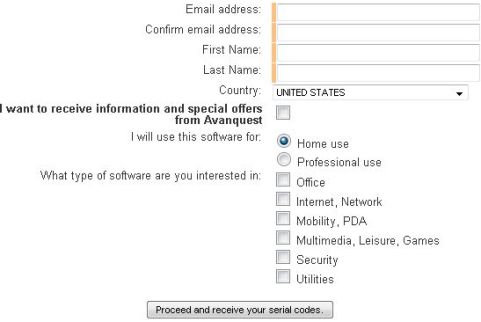
To grab a free copy of Avanquest PowerDesk Pro 7, visit the promotion page to complete the registration form, then your free license code for the PowerDesk Pro 7 will be delivered to your registered email address.

Download the setup installer of Avanquest PowerDesk Pro 7 from here.


Thursday, October 28, 2010

Firefox 4 release slips to 2011

Mozilla has pushed back the planned Firefox 4 release to 2011, a delay that's no surprise given the difficulties in releasing the first full-featured beta of the open-source browser--but that also gives breathing room for several competitors.

Mozilla had hoped to release Firefox 4 in 2010, but a newly updated Firefox 4 schedule shows the first release candidate arriving in early 2011.

"Development on Firefox 4 has not slowed down, and strong progress is being made daily. However, based on the delays in completing the 'feature complete' Beta 7 milestone against which our add-on developers and third-party software developers can develop, as well as considering the amount of work remaining to prepare Firefox 4 for final release, we have revised our beta and release candidate schedule," said Mike Beltzner, vice president of engineering for Firefox, in a mailing list message yesterday. "The frequent beta releases have been extremely helpful in identifying compatibility issues with existing web content, so we plan on continuing to release beta milestones through the end of December. Our estimate is now that release candidate builds will ship in early 2011, with a final release date close behind."

Six beta versions have arrived in recent weeks, but Firefox 4 beta 7 hasn't appeared, despite more than six weeks of frenzied development. One big issue holding up release has been the integration of Firefox's older Tracemonkey engine for running Web-based JavaScript programs and the new JaegerMonkey engine that draws on Google's V8 engine in Chrome.

Mozilla's arewefastyet.com site shows progress matching Safari and Chrome JavaScript execution speed, but new JavaScript engines can be tough to tune. Several JavaScript bugs are blocking Firefox 4 beta 7.

The JaegerMonkey JavaScript engine in Firefox 4, whose performance is shown here in purple, has proven competitive against the engines in Apple's Safari and Google's Chrome, as measured by the SunSpider and V8 benchmark suites.

The JaegerMonkey JavaScript engine in Firefox 4, whose performance is shown here in purple, has proven competitive against the engines in Apple's Safari and Google's Chrome, as measured by the SunSpider and V8 benchmark suites. (Click to enlarge.)

(Credit: Mozilla)

Among other changes in Firefox 4 are a revamped interface, a Bing search option, hardware-accelerated graphics, the new Jetpack foundation for add-ons to customize the browser, an HTML5 parser to interpret Web pages with the new standard for creating them, and WebGL for 3D Web graphics.

And presenting a major new front in the browser wars, Firefox 4 also works on Google's Android operating system for phones and other mobile devices. Today, the cutting edge in that market is dominated by the WebKit engine used on Android, Apple's iOS, and several other mobile operating systems.

Releasing the new version is important for Mozilla. Firefox remains the second most popular browser as measured by Net Applications usage statistics, but the browser market hasn't been as competitive as it is now in more than a decade.

Firefox and Opera kept the independent-browser fires burning during the years when Microsoft's Internet Explorer was dominant but somewhat dormant after its victory in the first browser wars of the 1990s.

In September's browser usage, IE dipped back below 60 percent share and Chrome gained 0.5 percentage points of usage.

In September's browser usage, IE dipped back below 60 percent share and Chrome gained 0.5 percentage points of usage.

(Credit: Net Applications)

Web technologies started picking up steam again, with Apple's Safari engineers joining the development effort begun by Opera and Firefox, and Firefox started wrenching significant share away from IE. But in the last two years, Google Chrome burst onto the scene, rising rapidly to third place and flattening Firefox's growth.

And even more recently, Microsoft began fighting back again with IE9, currently released in a first beta version. This browser was developed more in the open, letting outside developers get more of a say in its workings, and features many new modern abilities. Perhaps chief among them is ambitious hardware acceleration.

Firefox 4 has hardware acceleration, too, and unlike IE9 offers it for Mac OS X, Linux, and most important the vast number of Windows XP systems still in use.

Samsung Galaxy Tab First Coming To T-Mobile USA On November 10

T-Mobile has announced that they will be the first to debut the long-awaited Samsung Galaxy Tab Android-powered mobile tablet in the United States. The Galaxy Tab tablet is pre-loaded with Asphalt5 HD Demo racing game, Kindle for Android, Qik Video Chat and Slacker Radio apps, providing users an access to the newest movies and TV thanks to the Samsung Media Hub.

"Customers want richer, deeper interactions with entertainment and online content through connected, portable mobile broadband devices that are small enough to carry and big enough to share with friends and family," commented Jeremy Korst, director for broadband products and services at T-Mobile USA. "T-Mobile's unique offerings on the Galaxy Tab paired with the power of T-Mobile's new network allow us to bring a truly differentiated portable entertainment offering to market."

Samsung Galaxy Tab tablet based on Android 2.2 Froyo platform is expected to hit T-Mobile stores on November 10 for $399.99 based on a 2-year service contract for webConnect mobile broadband plan.


Gmail’s Auto-Advance Feature For Effective Emails Archiving or Deletion

Generally, Gmail will go back to your main Inbox after you have done with email deletion or archive which is not effective especially when comes to multiple emails processing. Wonder how you can effectively archive or delete any emails in Gmail without the need to go back and forth between Inbox? Now with Auto-Advance feature from Gmail lab, you can choose to enable the function depending on your preference and usage.

  1. From your Gmail account (assuming that you have logged in), go to Settings that is located at the upper right corner of your screen.
  2. Then go to choose Labs, and scroll down to Auto-Advance. Click the 'Enable' button to enable this feature. Click 'Save Changes' button to save the change.
  3. Now access the Settings again. Under General tab, browse to Auto-advance and select the desired setting. For instance, users can configure it to go to next (newer) or previous (older) conversation, or go back to the thread list after the actions.
  4. Once selected, click Save Changes and you are done.
  5. By now, it should be reflected and automatically show the next conversation or email after you delete, archive emails or mute any conversation, instead of going back into your Inbox.


Friday, October 15, 2010

Get your MY Clean N' Optimize 1.0.0.6

Clean N' Optimize has highly customizable cleaning options and supports the most common web browsers and chat applications. It has a built in Shredder, so the cleaned files/folders can not be recovered again and separate shredder to manually shred files, folders, drives empty space, and recycle bin with the most famous and secure shredding algorithms. It is a powerful optimizer for Internet connection, System like optimizing hard drive, Windows Explorer like disable save settings at shutdown and Privacy like locking some hard drive partitions. Also it has Startup Manager to modify the applications that launch at windows startup and Uninstall Manager to modify or uninstall the user-installed applications. With Clean N' Optimize you can clean your system with One Click. It has easy to use interface. The main window is just the start guide for you to use Clean N' Optimize in efficient and easy way. Read the instructions and follow the links to start using the program. The Clean Settings Window consists from 3 main sections: 1)Internet items includes the following, categories Browsers: in the browsers tabs, you can check items that will be cleaned in each installed browser and Chat: in the chat tabs, you can check the items that will be cleaned in each installed chat program. 2)System Items consists of the windows category which consists from History Cleaner: check the history items that you want to clean which are related to windows system and Recent Files Cleaner: check the recent files that you want to clean which are related to windows built-in, the hard drive cleaner will free up the hard drive space by deleting the temporary and unnecessary files, you can include files with specific Extensions to be deleted. 3)Registry Items: the Broken registry items means the leftover registry keys that should be deleted from the system registry. With shredder you can shred 3 categories:1)Shred Files/Folders, 2)Shred Empty Space, 3)Shred Recycle Bin.

[download]

Glary Utilities 2.27.0.982

   Glary Utilities offers numerous powerful and easy-to-use system tools and utilities to fix, speed up, maintain and protect your PC. It allows you to clean common system junk files, as well as invalid registry entries and Internet traces. Furthermore, Glary Utilities includes powerful functions such as disk analysis,software uninstaller,startup manager,memory optimizer,system info, duplicate files finder,secure file deletion and more.

[Free Download]

Glary Utilities

Get Genuine Avast 5 License Key Home Edition

If you need Avast license key, for Avast 5 Home Edition you can follow the tutorial on this post to get Avast 5 activation code.

Avast 5 Home edition is free for personal user but although Avast 5 free edition is free antivirus but Avast 5 require license key to activate it  for one year. If you do not entered the Avast 5 keys, this antivirus only works and active for 30 days or 1 month period after installation.

If you want your computer stay protected by this avast software, you must enter license key and this key will activate the antivirus for 1 year. But dont worry, we can get the license key Avast 5 on avast support website, the license key is absolutely free. If you need the serial key for avast 5 you can read and follow the steps below.

avast-5-registered

How to get license key for Avast! 5 free edition

  1. Open registration form for avast 5 at http://www.avast.com/registration-free-antivirus.php
  2. Completed the registration form then click "Register for free license" button. (You must enter valid email on registration form).
  3. Your free license key is sent within 24 hours by e-mail after registration. If the license does not come in 24 hours please check your junk or SPAM folder
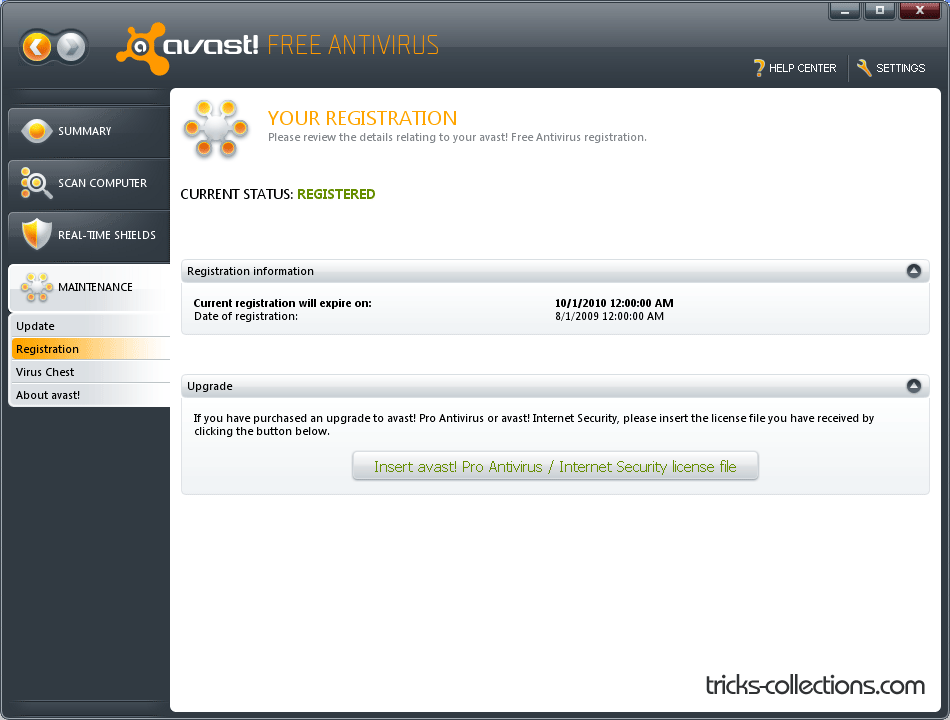
  4. To enter the license key, right click mouse at avast icon on windows taskbar then click "registration information". Click "Insert the license key" button and enter your license key.

If you have license key for Avast! 4.8, you can use the license key for Avast! 5, it work on Avast! 5. If you do not have download the key here: free genuine licence key avast 4.8 home edition for 1 year

Update: the genuine key avast 5 "W00205419C1200A0012-CML9F82S"

Kaspersky 2011 Trial Resetter

https://blogger.googleusercontent.com/img/b/R29vZ2xl/AVvXsEiUzkcDIiAZgJPGyEjEx1msKCDf9gU0kDfMsLVgsB3WvUdi95OGCuEbAu-uCbp7KSfoFf6Z38XqmhqxbER8NqbWxzQskGVAFz3uQHXvdb_HM7x9SFMWu_NboqDOjhyphenhyphenPIT3teHzQ6HyIpYP7/s1600/KasperskyInternetSecurity2011.jpg
hey guys, kaspersky is back this time and with greater benefits. Kaspersky have introduced their 2011 security solutions. Today we will share a very good link for Kaspersky 2011, which will enable users to reset their Kaspersky trial security solution. To avail this slolution, just click on the link below and then download the file and then install it:

Download - [Kaspersky 2011]

Thursday, October 14, 2010

How to activate Kaspersky Internet Security 2011 offline with key file!

The latest version of Kaspersky security products, Kaspersky Internet Security 2011 and Kaspersky Antivirus 2011 don't allow you activate the product with a key file (with .key extension) by default. If you are having only key file and want to activate the Kaspersky product, here is how to do it.

Kaspersky Internet Security 2011
In order to activate Kaspersky Internet Security 2011 and Antivirus 2011, you need to follow the simple steps given below. 

1. Open Kaspersky Internet Security 2011 or Kaspersky Antivirus 2011.

Activate Kaspersky with a key file

2. Click License: note installed button to open License management dialog box.


# Here, you will have two options:
       * Purchase license
       * Activate the application with a new license

Activate Kaspersky Internet Security 2011 with a key file

Click the second option (Activate the application with a new license) launch Kaspersky Internet Security Activation Wizard. Again, you will get options:

  * Activate commercial version
  * Activate trial version

 activate kaspersky antivirus 2011 offline with a key file

3. As you want to activate Kaspersky product offline using a key file, click Activate trial version.  As your Windows machine is offline, you will get see Activation error. Don't worry! Simply click Ok button to see Activate using key file option. 

 activate kaspersky 2011 with a key file

activate kaspersky 2011 offline with a key file

4. Browse to the Kasperksy key file (with .key extension) and click Next button to activate your Kaspersky product.

activate kaspersky 2011 offline activate kaspersky offline using key file 

5. You should see Activation completed successfully message along with your license type and expiration date details. Click Finish button and you are done.

Intel>>>>>>>>>>>> the ARM Wrestler<<<<<<<<<<<<<<<

Intel (Nasdaq: INTC) plans to pull out all the stops to conquer the tablet PC market, CEO Paul Otellini announced this week.

Intel will use all of the assets at its disposal to win this segment, he said. Intel will offer tablets running Meego, the operating system that's a melding of its and Nokia's (NYSE: NOK) technologies. It will also pursue Android and Microsoft (Nasdaq: MSFT) Windows, Otellini added. His statements were made during the company's third quarter earnings call.

Currently, the semiconductor giant is offering its Oak Trail processors for tablets. These are part of the Intel Atom family.

"We're already seeing tablets available now based on Intel Atom processors, including the Archos 9, Lenovo S10-3t, Cisco (Nasdaq: CSCO) Cius, and Asus eeePad," Intel spokesperson Suzy Ramirez told TechNewsWorld.

Can Intel's processors take on the A4 that's used by the iPad? Will Intel be successful in its plan to dominate the tablet PC market?

Hiding Out on the Oak Trail

Intel first announced the Oak Trail in June at the Computex show in Taipei. At that time, it said Oak Trail processors would be available to customers in early 2011

The Oak Trail platform is optimized for tablet and netbook designs. It consumes up to 50 percent less power than previous processors, offers full high-definition video, and is aimed at the Meego, Windows 7 and Android operating systems, Intel said.

Oak Trail is a system on a chip based on the Atom processor.

A system on a chip, or SOC, is a circuit into which multiple components are integrated. These may include digital, analog, mixed-signal and often radio-frequency functions.

Think of an SOC as a microcontroller on steroids -- where microcontrollers usually have less than 100 KB of RAM and are single-chip systems, SOCs use more powerful processors requiring external memory chips and various external peripherals. SOCs reduce manufacturing costs and let manufacturers reduce the size of their devices.

However, Intel's not letting out any more information about the Oak Trail processor.

"We have not disclosed any product features or additional details on Oak Trail," Intel's Ramirez said. "We've simply introduced the code name at this time. When it's announced, we'll offer more information."

Atomic Attack

Tablets running Intel's Oak Trail processors will be pitted against the iPad, which runs the A4 processor. The A4, designed by Apple (Nasdaq: AAPL) and manufactured by Samsung, combines an ARM-based CPU with a PowerVR graphics processing unit and features very low power consumption.

Will Intel be able to compete?

"Atom has all the right features and capabilities that are important for tablets, including low power, performance for multitasking, rich media and the Internet," Intel's Ramirez said. "We already have several tablet designs in the market that are enabled by the Intel Atom processor."

Perhaps Intel needs to do more work on the Oak Trail processor.

"They're talking about x86 technology, which isn't necessarily on par in power consumption with ARM (Nasdaq: ARMHY) technology, and ARM technology isn't standing still," Jim McGregor, chief technology analyst at In-Stat, pointed out.

"The Snapdragon and other ARM products won't be single-core devices but multicore devices. So in the first quarter of 2011, you'll have single-core Intel Atoms going up against multicore ARM-based devices that in some cases will have state-of-the graphics technology," McGregor told TechNewsWorld.

"This is a battle about architecture," Carl Howe, director of anywhere consumer technology, told TechNewsWorld. "Specifically, Otellini wants tablet computers to be x86-based, whereas the dominant tablet today, Apple's iPad, and most smartphones are ARM-based."

The Road Less Traveled

Perhaps Intel needs to rethink its approach.

"Apple's coming at the tablet market as a commercial product developer, and Intel's approach is to be a supplier of tablet developers who want to compete effectively against Apple," Charles King, principal analyst at Pund-IT, told TechNewsWorld.

"What Intel really needs to do is produce a robust platform that's also flexible enough to be tweaked for the discrete needs of different OEMs," King added. "That's a bigger challenge than Apple's 'one iPad fits all' approach, but should also result in Intel-based tablets that can be designed for the needs of numerous discrete audiences."

Intel's apparently doing just the opposite.

"At this point, Intel's sticking with what it's got -- Oak Trail," In-Stat's McGregor said. "It's not customizing this significantly for vendors, and it has segmentation within the Atom product for each market segment -- embedded chips, home consumer electronics, tablets and so forth. It's all within Intel's standard product offering."

courtsey: technewsworld

The Trouble With GUIs

It was only a month or so ago that Linux bloggers were feverishly debating the suggestion that perhaps it was time for the command line to go away. Here we are just a few weeks later, however, and it's the flip side of that question that's being discussed.

"Take this GUI and shove it" was the title of the InfoWorld post that brought the topic back to life again, this time with a focus on the oh-so-helpful graphical user interface.

"I find nearly all GUI management tools for network devices and servers more trouble than they're worth," wrote Paul Venezia, the author of the post.

"This preference isn't techno-codgerism, it's based on the reality of day-to-day network and server administration," Venezia added, citing a number of examples to support his case.

"GUI interfaces are fine and necessary in many cases," he concluded. "But they need to be built after a complete CLI is already in place, and they cannot interfere with the use of the CLI, only complement it. Otherwise, all you've done is make easy things easy and hard things much harder."

In what seemed like a matter of seconds, the thundering hooves of the Slashdot herds could be heard in the distance, galloping at full speed to have their say.

'The Worst of Both Worlds'

"Providing a great GUI for complex routers or Linux admin is *hard*," wrote alain94040, for example. "Of course there has to be a CLI, that's how pros get the job done. But a great GUI is one that teaches a new user to eventually graduate to using CLI."

Of course, "a bad GUI with no CLI is the worst of both worlds, the author of the article got that right," alain94040 added.

"What would be nice is if the GUI could automatically create a shell script doing the change," suggested maxwell demon. "That way you could (a) learn about how to do it per CLI by looking at the generated shell script, and (b) apply the generated shell script (after proper inspection, of course) to other computers."

'All But Brain-Dead'

Then again: "What would be REALLY nice for you all router manufacturers who are using Linux underneath the hood is to give shell access so that we could gain full access to iptables, vpn and routing," chimed in MightyMartian. "Just about every one of these Linux-based routers has all that power locked up in your crappy web-based configuration tools that render them all but brain-dead.

"Yeah, I know, there's DD-WRT and its various iterations, but these only work on a subset of Linux-based routers," MightyMartian added.

Remembering the vehemence of last month's command-line debate (just check out those comments!), Linux Girl felt the need for some liquid courage before digging any deeper. She made a beeline for the blogosphere's rowdy Punchy Penguin saloon.

'GUIs Are Rarely Able to Be Automated'

"As somebody that does a lot of scripting, I find that if a tool has a great command-line interface, it is *far* easier to automate the tool than a similar GUI tool," offered blogger Jeremy Visser.

"GUIs are rarely able to be automated (except in the case of simple web interfaces -- if you can call them GUIs at all), so automating a task to replace a GUI usually requires reinventing the wheel with a command-line script -- usually one I will end up writing," Visser explained.

"Definitely agree, with nearly every point," Slashdot blogger David Masover told Linux Girl. "The strength of the CLI is that it's both an interactive tool and an API, which means we can write tools and scripts, which means we can automate away part of system administration, which should cut costs, improve reliability, and make our jobs more interesting.

"I would rather have a command line for system administration in particular, and even where I'd prefer a GUI, it'd be nice if it was driving a command line, or if it at least provides a command line," Masover added.

'I Am More Productive Than With a GUI'

"When I was in college I learned command-line FTP before they brought in nice GUI clients," Chris Travers, a Slashdot blogger who works on the LedgerSMB project, told Linux Girl. "I found that the best GUI clients required several steps to what I could do with one short command on Windows 3.1's command-line client."

So, instead of "get foo.txt a:\bar.txt," Travers said, "I'd have to go through selecting where I wanted to download the files to, download the file, and then rename it. This is considerably longer than simply telling the computer what I wanted done."

Now, "when I write code, it's entirely at the command line (VIM)," Travers added. "I do this because I am more productive in these environments than I would be with a GUI."

'A Question of Density of Information'

In general, "I think it's worth thinking of the GUI vs the command line interface as a question of density of information," Travers suggested. "There are definitely times when the GUI gets in the way."

GUIs excel at "presenting information from the computer to the user, and are much better than a command-line interface in this regard, but the information they receive from the user is simpler and less dense," he explained. "A web browser is a perfect example of a tool which is generally far more useful with a GUI, but sound recording software benefits from having a GUI because the feedback that must be offered in the process of using the software is generally fairly rich."

Where a GUI breaks down is in user input, Travers asserted.

"A few keystrokes have far more informational value than several mouse-clicks in most circumstances, and it's usually faster to type out a rich, complex command sequence then to try to enter it via a GUI," he concluded.

'Typed Commands Do It Now, Instantly'

The GUI is "a great tool for multitasking," blogger Robert Pogson suggested. "However, the GUI is terrible if you want to *really* control a bunch of processes, or stop them."

For example, "I can 'pkill -f iceweasel' and kill all instances of iceweasel much sooner than I could close all its windows one at a time," Pogson explained. "Once a GUI has to deal with more items than fit in the window, it is hopeless unless CTRL-A does what you want."

In short, "the GUI is a great tool for most things, but it sags for power users, system administrators and little people who have a big job to do," Pogson concluded. "You can write a GUI tool to do some of these things but why bother? Typed commands do it now, instantly."

'It Depends'

"It depends on what you're doing," asserted Barbara Hudson, a blogger on Slashdot who goes by "Tom" on the site. "For remote work, there's nothing that beats having a few shells open. WHM and cPanel more often than not make simple tasks harder -- or impossible."

"Like everything else in life, it boils down to having the right tool for the right job ... and the command line is like that all-purpose screwdriver that we all have," Hudson added. "It opens paint cans, makes a handy chisel, pry bar and wedge -- we grab it, get the job done, and move on."

Similarly, "whether a GUI or CLI is better depends entirely on who needs to access it," Montreal consultant and Slashdot blogger Gerhard Mack opined.

'I Still Have Nightmares'

On the server side, for instance, the author "is exactly right," Mack said. "As an admin, I hate GUI-only systems. I still have nightmares about a certain large computer maker offering 'enterprise' switches that were rebranded from another manufacturer and having to lock the switch down to switch port based VPN and having to go through ALL 24 ports on the switch one at a time to set the new VPN and a second time through all 24 ports to remove the default one.

"To be fair, they could have made a better GUI that would have cut my time down considerably, but that still pales in comparison to the 5 minutes it would have taken me with a decent CLI or the 10 minutes it would have taken me to script around a bad CLI," he explained.

For home users, however, "the GUI will always be better, and if we want Linux to attain more market share, we will need to continue to make the GUI better and more intuitive," Mack added.

'They Want Lots of Hand-Holding'

Indeed, "CLI is great for the server where there are these things called 'admins' that have actually gone to school and are getting paid to deal with it," Slashdot blogger hairyfeet agreed. "On the desktop? So full of fail it is practically overflowing."

For proof, one need look no further than the fact that "the ONLY Linux that is selling is Android," hairyfeet pointed out. "What is Android? It is a pretty, GUI-BASED phone with *absolutely NO access to CLI* by the common user. None at all.

"You have to give your CUSTOMERS -- which is what they are, folks -- what they want," hairyfeet concluded. "And what they DO NOT want is CLI. What they want is nice little wizards and lots of hand-holding and 'it just works' without needing a degree in comp sci just to run the stupid thing."

courtsey: technewsworld